Does our business appear when buyers ask AI?
Test how your business appears in AI answers to relevant buyer questions. Compare service descriptions and named alternatives, then inspect the evidence behind the findings.
Flexible participation. Powerful analysis.
Compare perspectives and build understanding with assessments and Micro Learning. As customers use AI to find solutions, see whether your business appears in their answers and how your services are described.
01
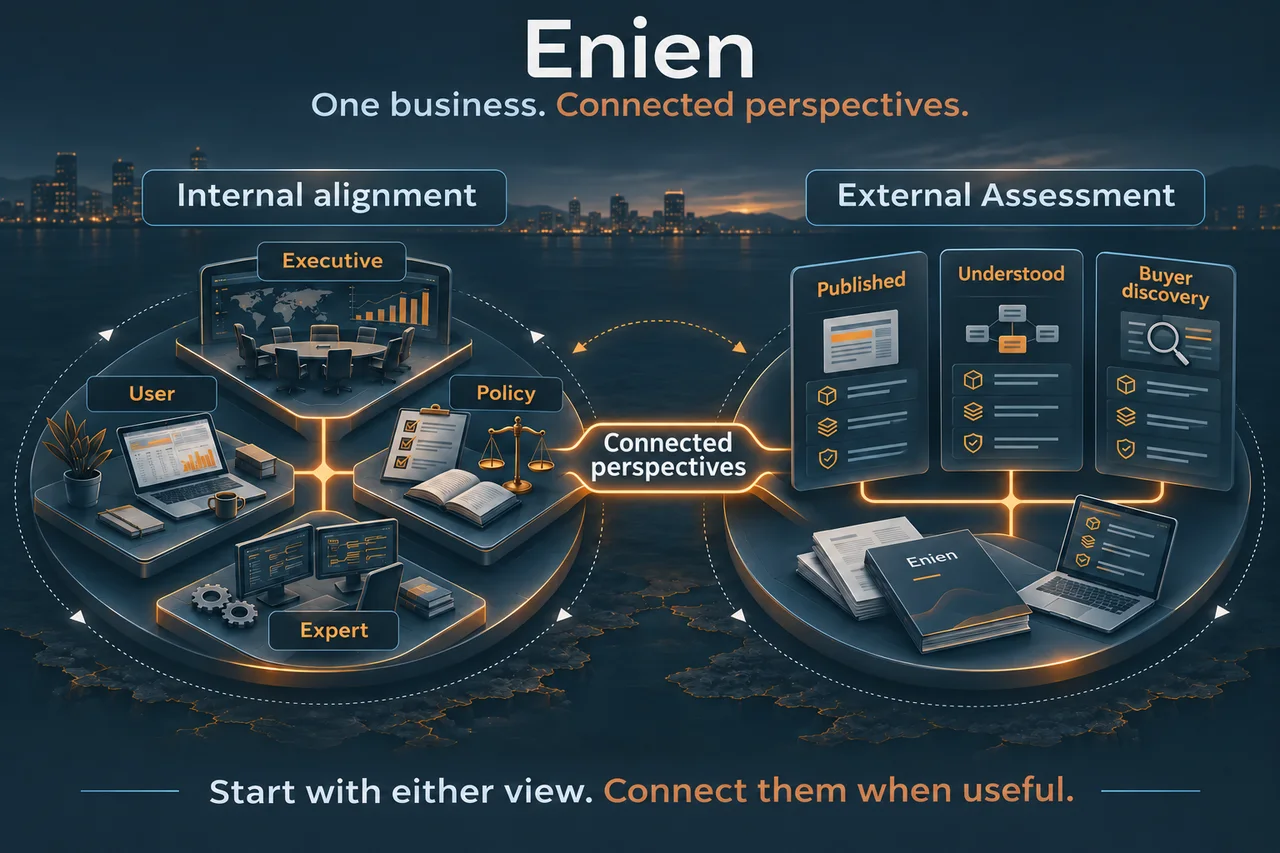
Choose an external view of your business, an internal view of how it works, or connect the two. Each starting point has value on its own.
Test how your business appears in AI answers to relevant buyer questions. Compare service descriptions and named alternatives, then inspect the evidence behind the findings.
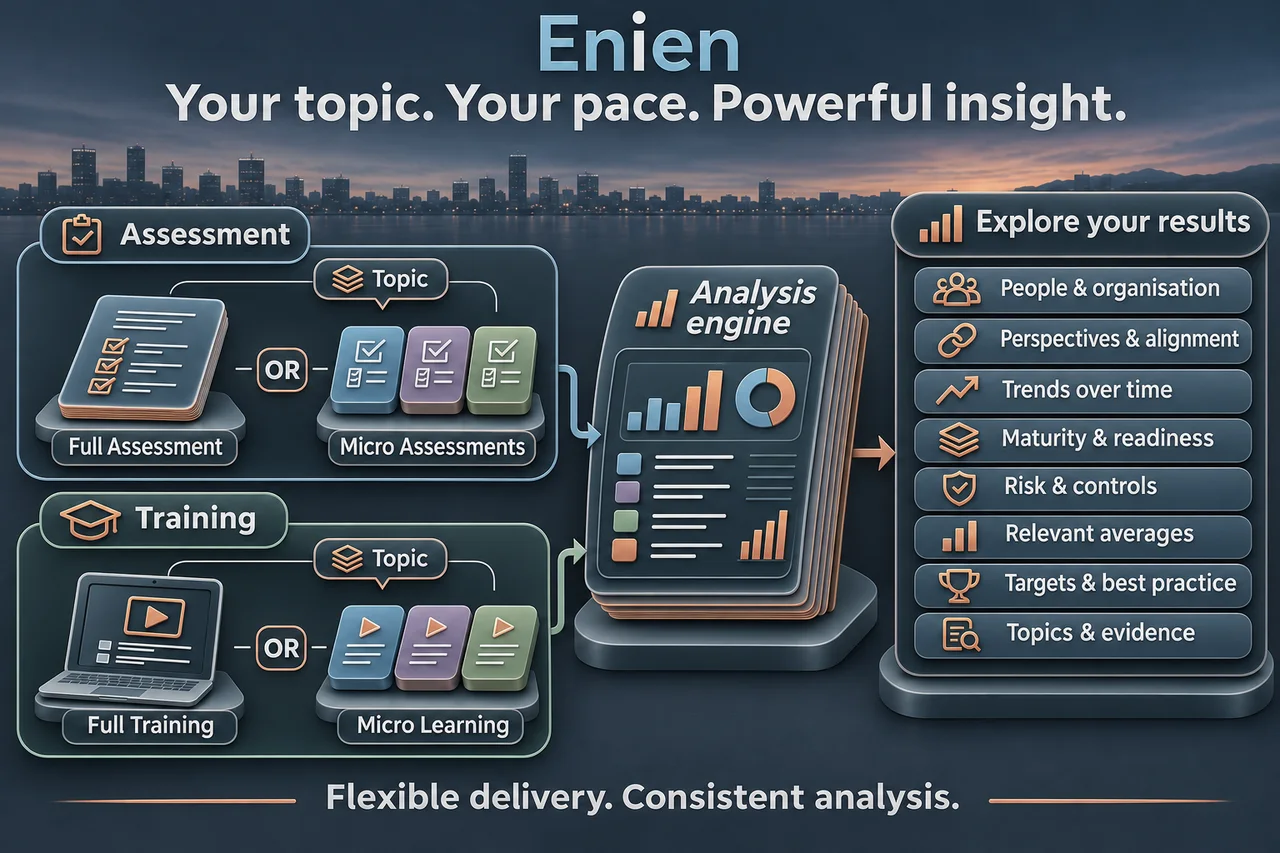
Choose full assessments or Micro Assessments, full training or Micro Learning. Use Enien analysis to compare results and understand differences across your organisation.
02
Choose the way that suits the topic and the people taking part. Work through the assessment or training in one go, or complete it a topic at a time.
Your delivery choice retains the Enien analysis. Learning outcomes and assessment responses remain distinct.
03
Your delivery choice retains the power of the Enien engine. Explore patterns, differences and changes, put results in context and use the detail to decide where to focus.
Explore differences across individuals, teams, divisions and geographies, and between leadership, user, policy and expert views.
Compare compatible completed assessments to see how the picture changes across dated observations.
Explore maturity, readiness and risk alongside relevant averages, contextual targets and applicable best-practice references.
Use the differences to focus attention, drill into topics and question-level evidence, and communicate the findings through reports.
Available views depend on the assessment type, scope and recorded evidence. Trends use compatible completed assessments. Observed averages, organisational targets and best-practice references remain distinct.
04
Use the evidence to build a shared understanding, investigate a difference or decide where a change would help. These examples show how findings can support a decision.
Start with the evidence, agree the next step and who will take it, then revisit the topic when useful.
05
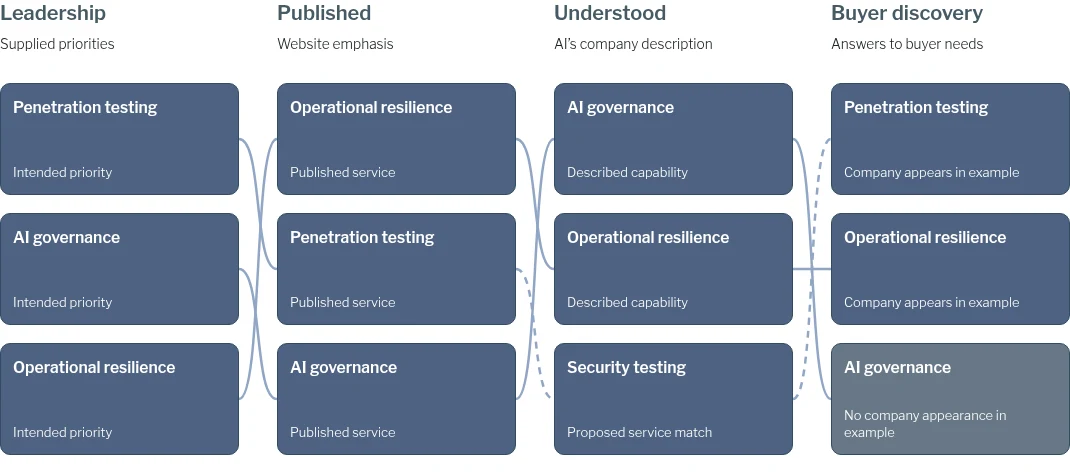
Customers use AI to explore solutions and compare providers. See whether your services are clearly described and your business appears in relevant buyer answers. Compare those observations with supplied leadership priorities.
06
QuadraView compares executive, user, policy owner and expert perspectives. PentaView adds External Assessment, helping you explore where the views inside your organisation and the picture outside align or differ.
Use the comparison to ask better questions, prioritise attention and support discussions with teams, boards and advisers.
07
Defined scope, quality checks and retained evidence give AI responses a clear assessment context.
Evidence and review status support judgement. Consider AI responses against the relevant facts and context.
Participants can use their account or a secure invitation or campaign link, depending on the programme setup. Email delivery needs an email address. Anonymous campaigns use their own participation settings.
Yes. Complete the same assessment in one go or topic by topic through Micro Assessments. The original questions and saved responses feed the same Enien analysis and reporting once the required assessment scope is complete.
Yes. Scope content around the topics, question groups or sections of a framework that matter to your organisation.
Learning and assessment have different purposes. Learning helps people understand a topic; assessment responses provide the input to the assessment result. Keep the two clear when designing a programme.
Yes. External Assessment can stand alone, looking at your published services, how AI understands you and whether relevant buyer questions surface your company. It can also add the external perspective to internal alignment work through PentaView.
Enien works within a defined assessment scope, uses question-quality checks and recorded reviews, and retains the responses and evidence behind the findings. Coverage, proposed service matches and interpretation status stay visible. The process helps you inspect and challenge AI output; it does not guarantee every answer is correct.
Micro Assessments deliver an assessment in small, coherent groups of questions, such as one topic at a time. Micro Learning delivers training in short, focused learning sessions. You can also complete the assessment or training in one go.
Enien supports comparisons across people and organisational groups, differences between perspectives, trends over time, and maturity, readiness and risk views. Relevant averages, contextual targets and best-practice references help put results in context. Drill into topics, questions and supporting responses or evidence, and communicate findings through reports. Available views depend on the assessment type, scope and recorded evidence.
Yes. Compare compatible completed assessments from different dates to see how results change. Comparable question coverage and the assessment dates matter: a change in scope or population should be considered when interpreting the trend.
Useful outcomes include a shared understanding, further investigation, a decision to keep the current approach or a targeted change. Examples include focusing learning, reviewing a policy or control, prioritising resources and checking progress. Use the relevant evidence and business context to choose the next step.
Tell us the problem, the people involved and where you would like to start.
Already a customer? Sign in to your workspace.